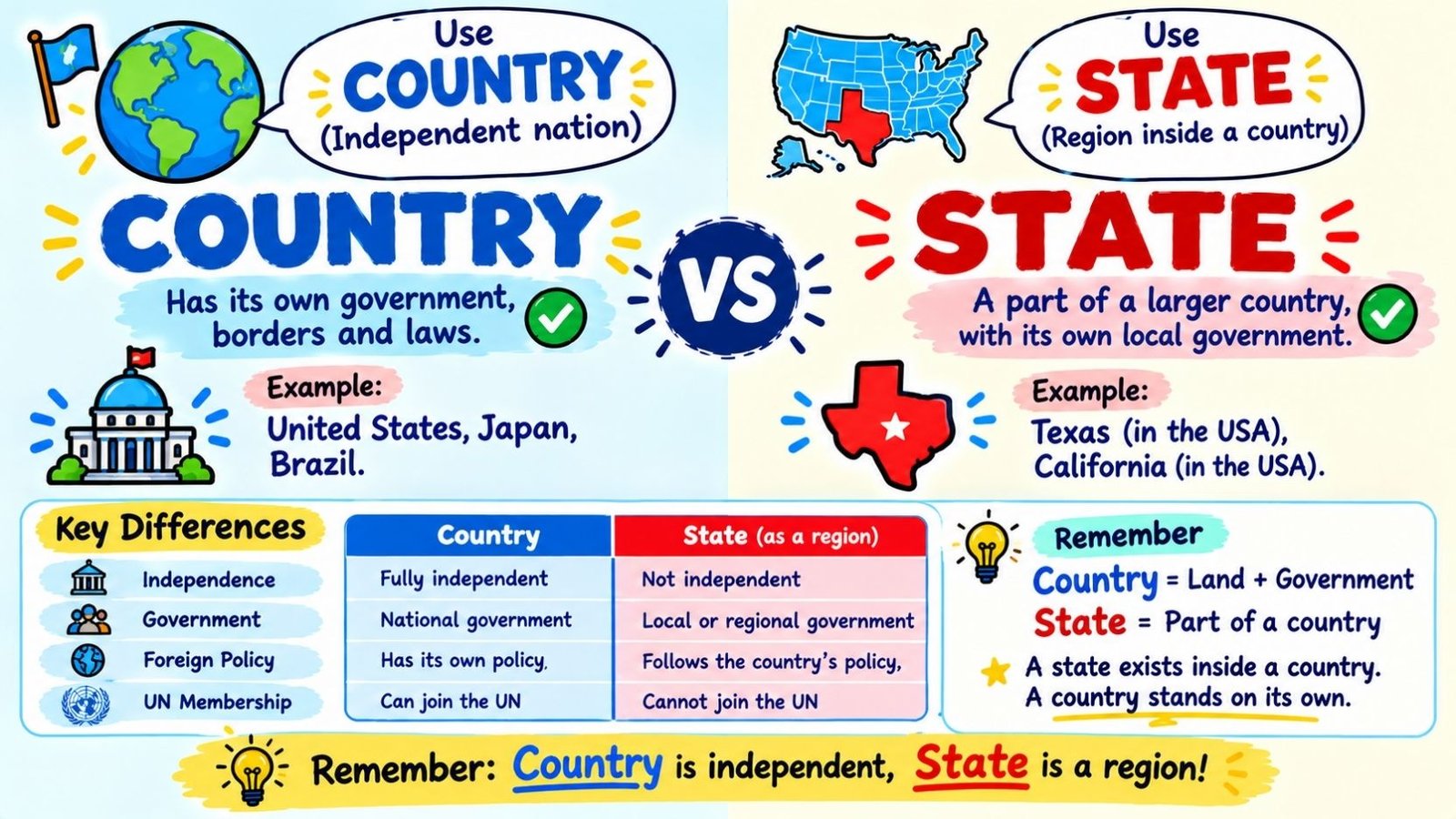
Many people use “country” and “state” as if they mean the same thing. They do not. A country is an independent place with its own government and recognized borders. A state can mean two very different things: an independent country, or a smaller region inside a larger country, like Texas or California.
This confusion grows when terms like nation, province, continent, and constituent country enter the conversation. Each word carries its own legal and political weight. Understanding country vs state helps you read news, maps, and legal documents correctly, and it helps you avoid awkward mistakes in writing or conversation.
Country Meaning
A country is a geographic and political area that governs itself. It has defined borders, a permanent population, its own laws, and the ability to make decisions without needing approval from another nation.
Most countries are also sovereign states. This means they are recognized by other nations and can join organizations like the United Nations.
Simple examples of countries include:
- The United States
- Japan
- Brazil
- Kenya
- Georgia (the country near Eastern Europe)
💡 Tip: If a place has its own army, its own currency option, its own seat at the UN, and its own foreign policy, it is almost always a country.
State Meaning
“State” is trickier because it has two separate meanings.
Meaning 1: State as a sovereign country
In political science and law, “state” can mean a fully independent nation. This is the formal meaning used in terms like “nation-state” or “sovereign state.”
Meaning 2: State as a region inside a country
In everyday American English, “state” usually means one of the smaller political divisions inside a larger country. The United States has 50 of these. Australia and India also use this system.
So when someone says “Texas is a state,” they mean the second definition: a region with its own local government, but one that still follows the laws of its national government.
Country Vs State: Key Differences
| Feature | Country | State (as a region) |
| Independence | Fully independent | Not independent; part of a larger country |
| Government | Has national government | Has regional or local government |
| Foreign policy | Sets its own foreign policy | Cannot set foreign policy |
| UN membership | Can join the United Nations | Cannot join the United Nations |
| Example | United States, Canada, France | California, Texas, New York |
This table shows the core country vs state difference in one glance. A country stands on its own. A state, in the everyday sense, exists inside a country and follows that country’s federal laws.
Country Vs State Vs Nation
Many readers search for country vs state vs nation because these three words seem interchangeable. They are not.
- Country refers to a political and geographic territory with borders and a government.
- State, in its formal sense, refers to the governing authority of a country. In its everyday American sense, it refers to a region within a country.
- Nation: refers to a group of people who share culture, language, history, or identity. A nation does not need official borders.
Here is a simple way to remember it: a nation is about people and identity. A country is about land and government. A state is either the governing structure of a country, or a smaller region inside one, depending on context.
⚠️ Common mistake: Calling every country a nation is usually fine casually, but in careful writing, remember that a nation can exist without a country. The Kurdish people are often described as a nation without their own independent country.
Nation Vs Country Vs State
This phrasing flips the order, but the meaning stays the same as above. Readers searching this version usually want the same clarification: nation focuses on shared identity, country focuses on territory and sovereignty, and state focuses on governing structure or regional division.
Continent Vs Country Vs State
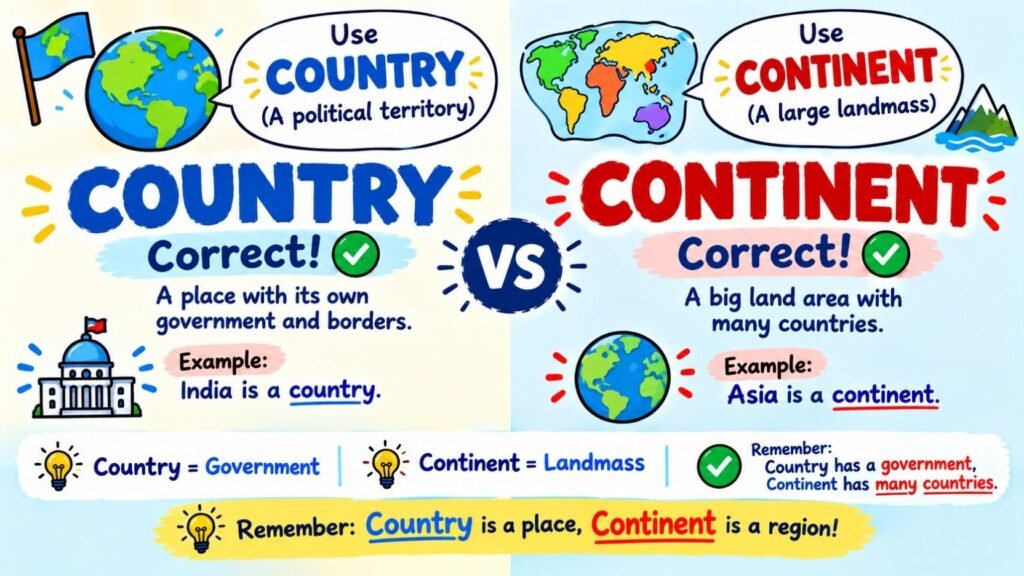
A continent is the largest of these three categories. It is a broad landmass, like Asia, Africa, or South America. A continent can contain dozens of countries.
- Continent: Africa
- Country: Nigeria
- State: Lagos (a Nigerian state)
So the size order typically runs like this: continent, then country, then state. A continent holds many countries, and a country can be divided into many states.
Country Vs State Vs City
A city is smaller than a state and sits inside it. Cities are urban centers with their own local government, but they answer to both state and national law.
- Country: United States
- State: Illinois
- City: Chicago
This hierarchy helps explain how government layers work in countries that use a federal system.
Constituent Country Vs State
This is one of the more advanced distinctions, and it often confuses readers researching the United Kingdom.
A constituent country is a country that exists inside a larger sovereign state but still carries the label “country.” England, Scotland, Wales, and Northern Ireland are constituent countries of the United Kingdom. They each have cultural identity, and some have their own parliament, but none of them are independent nations on the world stage.
This differs from an American state. A US state like Ohio is not called a country at all. It is simply a state, with no separate national identity recognized internationally.
| Term | Example | Independent? | Called a Country? |
| Constituent country | Scotland | No | Yes |
| US state | Ohio | No | No |
So a constituent country vs state comparison comes down to naming and historical identity, not actual political independence. Neither one is a sovereign nation, but only one keeps the word “country” in its official name.
Georgia Country Vs State
This search appears often because two very different places share the same name.
Georgia the country: sits in Eastern Europe, near the Black Sea, bordering Russia, Turkey, Armenia, and Azerbaijan. It is a fully independent nation with its own government, currency, and UN seat.
Georgia the US state: sits in the southeastern United States. It is one of 50 American states and follows US federal law.
| Feature | Georgia (Country) | Georgia (US State) |
| Location | Eastern Europe | Southeastern United States |
| Capital | Tbilisi | Atlanta |
| Independent | Yes | No |
| Currency | Lari | US Dollar |
They share a name by historical coincidence, not by political connection. Confusing country of Georgia vs state of Georgia is one of the most common country vs state mix-ups online, and it often shows up in travel searches, insurance searches, and trivia questions.
Country Vs State Size Comparison
People often assume a country is always larger than a state, but that is not guaranteed. Size depends entirely on the specific country and the specific state.
For example, Alaska, a single US state, is larger in land area than many fully independent countries, including France and Germany. Meanwhile, small countries like Monaco or Vatican City are far smaller than most American states.
So a country vs state size comparison should always be looked at case by case rather than assumed. Political status, not physical size, is what separates a country from a state.
Country Vs State Examples
Clear examples make this distinction easier to remember.
Countries:
- Canada
- Germany
- India
- South Africa
US States:
- Florida
- Oregon
- Michigan
- Arizona
Constituent Countries (inside the UK):
- Wales
- Scotland
Notice how countries stand independently, while states and constituent countries exist as parts of something larger.
Common Mistakes
Many writers blend these words without realizing the legal difference.
❌ Incorrect: “Texas is a country inside America.”
✅ Correct: “Texas is a state inside the United States.”
❌ Incorrect: “The United Kingdom is a state.”
✅ Correct: “The United Kingdom is a sovereign country made up of four constituent countries.”
❌ Incorrect: “California has its own foreign policy.”
✅ Correct: “California follows the foreign policy set by the United States federal government.”
These mistakes usually happen because “state” has more than one valid meaning, and writers forget to clarify which one they intend.
Similar And Related Words
| Word | Meaning | How It Differs |
| Province | A regional division, common in Canada and China | Similar to a US state, but used in different countries |
| County | A smaller administrative unit inside a state | Smaller than a state; found within it |
| Territory | A region controlled by a country but not fully a state | Often lacks full political representation |
| Sovereign state | A fully independent country | Technically identical to “country” in formal use |
Understanding these related terms helps avoid confusion when reading about different political systems around the world.
Frequently Asked Questions
What does country vs state mean in simple terms?
A country is an independent nation with its own government. A state usually means a smaller region inside a country, though it can also formally mean a sovereign nation.
Is a US state considered a country?
No. A US state is not a country. It is a political division inside the United States and does not have independent sovereignty.
What is the difference between country, state, and nation?
Country refers to land and government. State refers to a governing structure or a regional division. Nation refers to people who share identity, culture, or history.
Why does Georgia refer to both a country and a US state?
This is simply a naming coincidence. Georgia the country in Eastern Europe and Georgia the US state in the southeastern United States are unrelated politically.
Are constituent countries independent?
No. Constituent countries like Scotland or Wales are part of the United Kingdom and do not have full sovereignty, even though they keep the word “country” in their name.
Is a continent bigger than a country?
Yes. A continent is a large landmass that typically contains many countries.
Can a state be bigger than a country?
Yes. Some US states, such as Alaska, are physically larger than several independent countries.
What is the difference between a state and a province?
They serve a similar purpose. “State” is used in places like the United States and Australia, while “province” is used in countries like Canada and China.
Conclusion
The country vs state comparison comes down to independence and governing structure. A country is a self-governing nation with full control over its laws and foreign policy. A state, depending on context, is either the formal term for an independent nation or, more commonly in everyday American English, a smaller region that exists inside a larger country, like California or Georgia.
Once you understand this distinction, related comparisons become much easier to follow, including country vs state vs nation, country vs state vs city, and constituent country vs state. Keeping these definitions clear will help you read news, maps, and official documents with more confidence, and it will help you avoid common mistakes when writing or speaking about geography and government.

Aarav Sharma is the author behind Gram Vella, dedicated to making English grammar, vocabulary, writing skills, and language rules simple and easy to understand. Their goal is to provide accurate, helpful and easy-to-follow explanations that help readers improve their English with confidence.